Tuesday, March 8, 2016

SAFETY AT SEA SEMINAR


Even in a pool, it's a bit of a challenge

The ’Safety at Sea’ seminar was held on Bainbridge Island the weekend of March 5th and 6th. Sanctioned by US sailing, it was put on by The Sailing Foundation.   The certification resulting from successful completion of the seminar is a requirement for many offshore sailing races.
Before I lose you, if there’s one single takeaway from the seminar, it’s ‘read the instructions and practice with the safety equipment’.  It’s more than that, as it was an entire weekend ( 9 to 5 Saturday, 9 to 5 Sunday), but the essence of the seminar was promoting solid seamanship skills to avoid using the safety equipment, but if you have to use it, know it before you use it.

While there are risks with being on the water, sailing is a fairly safe sport.  Accidents are few and far between.  One of the sessions involved a critical review of accidents between 2011 and 2013.  Fatal accidents are tragic and understanding the events and what could have been done to avoid them is a sobering exercise.  That said, there simply aren’t that many fatal accidents.   Of the fatal sailing accidents many involved high tech boats pushing the envelope in both design and usage.

The seminar brought together regional — and in many cases they are also national — experts on safety equipment, medical issues, weather and weather routing, sail design, and heavy weather sailing.

It’s difficult to create a seminar that addresses all aspects of safety, more difficult when the audience is comprised of a wide scope of sailors.  There were elite sailors in attendance.  Transpac, Vic-Maui, and Sydney-Hobart were mentioned in a casual, understated way.  Quiet competency in a “been-there-done-that” type of crowd.

Others in attendance were cruisers and some were newer to sailing looking to learn more.  Many of the presentations and techniques assumed a fully crewed racing sailboat.  There are adaptations to shorthanded sailing, but no single technique will work for all boats in all conditions.

That was probably the core strength of the seminar — attendance did not result in a transference of knowledge to solve all problems.  The seminar was more a catalyst to get back to your boat, assess what equipment you do or don’t have, then prepare the boat, yourself and the crew to actually use the equipment.

For myself, I’ve had a life sling on the boat for years.  Probably 20 years.  It’s become an accepted accessory on the aft rail.  Last year I thought, I should probably take a look at that, so I took it out of its bag.  Or at least tried to — the plastic sling and more or less welded itself to the bag.  It took several minutes of coaxing to pull the thing out of the bag.  Talk about a teachable moment.  The thought of doing that at night or in ugly conditions just after a worst case scenario leaves me shaking my head.

I also don’t have a block and tackle so my first mate could haul me aboard.  And in truth I’d need mechanical assistance hauling someone else aboard.

And we both need practice at actually doing it.

I’ve also cannabilized my throw bag so carefully prepared for the circumnavigation of Vancouver Island 5 years ago.

And I don't have a field medical guide on board.

The list goes on and on.  While the vessel passed the power squadron safety check, that check, after watching it done a couple of times by two different reviewers, is more regulatory in nature and ensures the vessel meets coast guard requirements.  The thrust of the seminar was to engender a culture of safety that often exceeded CG requirements.

The additional difference is that the power squadron, while welcoming sailboats, is primarily for power boats and ’coastal’ in nature.  This seminar was solely for sailboats and offshore in nature.

Some highlights of the Seminar

Hands on fire extinguisher use with instruction from the assistant chief of the Bainbridge Fire Department.

SOLAS approved smoke device

The flare on the left is GG approved the one on the right is from SOLAS

A couple of examples of SOLAS (Safety Of Life At Sea) products that, to our eye, performed better than the standard issue Coast Guard approved equipment.

Doug Fryer
Ryan Helling gave the LifeSling presentation, backed by Doug Fryer.   Doug is well known on the sound and was part of the team that developed the Lifesling.  It doesn't get much better to have his informed observations heard on how to use the Lifesling.
Brad Baker
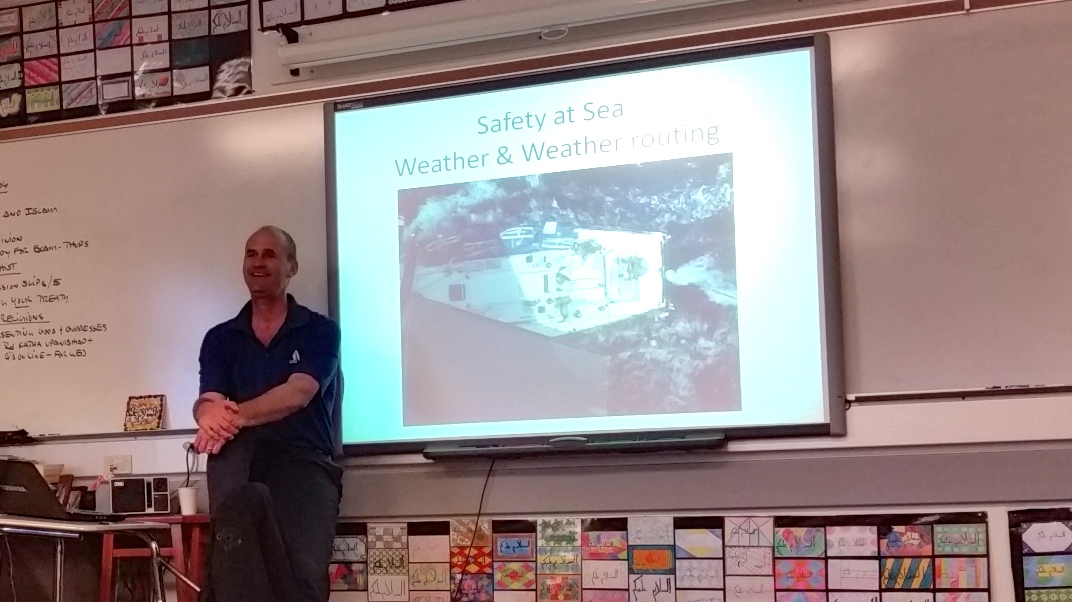
Brad Baker held court on weather and weather routing.  With 9 Vic-Maui's under his belt (in 5 of them he won the Navigators award) everyone paid attention.


Carol Hasse

Carol Hasse gave an excellent summary on sail selection and repair.  She also triggered new thoughts on when and how to use a Trys'l.  They may not be all about heavy weather sailing....

There's no elegant way to enter a life raft.  It takes communication and the 'ol "one-two-threeeeeeeee"
Margaret Pommert assists a fellow sailor

Up

And over

And in

The last sequence involves the newly boarded to face plant.  It certainly can be done, we all got in, but you get a full appreciation of the effort involved.....in a calm, heated pool, under controlled circumstances with only peer pressure at play.   In breaking seas at night, (or at any time) this would be the absolute last resort.

When they say "6 Man" they really mean it.  There isn't room for much else.

Was the seminar useful?  For me, unquestionably yes.  Less than 24 hours after the seminar, the block and tackle to support the life sling is now stowed in the cockpit locker.  But that's not enough.  Plans have been made to test the life sling.  Better put, test ourselves using the lifesling.  Are we able to deploy it under sail and get it to a target?  Are we able to retrieve a person out of the water?  Do we have the leads right so that we can get the line effectively to a winch?  

While not centered on cruising, this seminar had plenty for the cruising sailor.  Takeaway tidbits through out the weekend to not only add to the knowledge base, but serve as catalyst for action.

Read the instructions, practice with the gear.  Working out the kinks before something happens.  

It would be silly to think you can anticipate all unforeseen events, but having practice sessions on the most likely events serves as a base from which you can adapt.  While a required course for many offshore races, any sailor -- or for that matter power boater, could take the presented concepts and adapt them for their own style of boating.

For more information, go to www.ussailing.org/safety  and www.thesailingfoundation.org


Saturday, March 5, 2016

IT'S RAINING, IT'S POURING, GREAT TIME FOR A SAIL!


The NOAA forecast for Friday was 15 to 20, building to 20 to 25 in the afternoon.  Windyty’s charts showed a peak of perhaps 15 knots at noon, dwindling to about 5 knots in the afternoon.  As I rounded the Shilshole breakwater it was blowing 15 with some slightly stronger gusts.  I’m single handling a Mapleleaf 42 and decided on two reefs, just to be safe (don’t want to break the glassware) and tacked across the sound, headed for Eagle Harbor.


For about an hour it was a lovely sail.  Just under 6 knots over ground and as the rain hit, the wonder of sailing in an enclosed cockpit with a full windshield hit me again for the umpteenth time.  Laugh at the windshield all you want.  Call it a ‘trawler with a stick’.  I was having fun.  Dry and comfortable in a driving rainstorm.

Last year in February I had been in Port Ludlow and on a Sunday headed back to Seattle.  Small craft warnings and just been posted by NOAA about an hour before I left, but didn’t cause too much concern.  Two hours later I was in a near gale burying the bow on multiple occasions.  Two local meteorologists who later reviewed the available information leading up to the event suggested that someone at NOAA was effectively (or ineffectively) asleep at the wheel.  They blew a forecastable event.

Which is why, on this current day, I had chosen to put 2 reefs in the main.  But as the afternoon wore on, and the wind dropped exactly as Windyty predicted, I finally lowered my sails.  And my faith in NOAA.

The purpose of the trip was a ‘safety at sea’ seminar, but the club dock had been reserved for a ‘mini cruise’ event.  I had signed up for the event, but acknowledged I would miss many of the activities owing to the seminar.

Docking took place without incident and I was very fortunate to join 3 different groups of folks throughout the night.  Great evening and looking forward to the seminar tomorrow.

Monday, February 29, 2016

CMA-CGM BENJAMIN FRANKLIN

Shot from Sunset Hill, the Benjamin Franklin steams south towards Seattle

At 2130 hours last Sunday night the largest container ship ever to enter the Salish Sea rounded Cape Flattery and began her first ever trip down the Strait of Juan de Fuca.  She loafed down the straits well under normal cruising speed and on Monday at 0630 passed by Shilshole.   90 minutes later the UK flagged ‘CMA-CGM Benjamin Franklin’ berthed at Seattle’s Terminal 18.

She’s 1,309 feet long, 177 feet wide and draws 53 feet.  Fully loaded she can carry 18,000 TEU’s (twenty foot container equivalents).  For comparison, that’s roughly the entire annual volume for Limited Brands.  In three trips she could hold all of Gap’s annual product.  She burns 330 Tons of fuel each day.  Within 200 miles of the US coast she burns low Sulphur fuel and while docked the engines are turned off and city power is utilized.

Not only was she the largest container ship to enter the Salish Sea, she is currently the largest container ship to ever dock in North America.  Launched last December, this was her second trip and at the moment, she can’t be filled to capacity to call on any West Coast Port.  The cranes at the Port of Los Angeles can only lift to 133 feet high.  Seattle has cranes that can lift to 145 feet.  If the Benjamin Franklin was fully loaded, she’d need cranes that could lift to 170 feet high.

This ship is only the first in a wave of mega-container ships.   By way of comparison, many of the larger container ships calling into Seattle are 8 to 10 thousand TEU’s (20 foot containers).  At 18,000 TEU’s, the Benjamin Franklin is a quantum leap larger.

While they are more economical for carriers to move freight and they appear to be more efficient to unload (according to data from the Journal of Commerce) they do create challenges for terminals.  Harbor depth is not an issue in Seattle, but depth in the berth is.  Considerable infrastructure would be needed to maximize the usage of these ships.


Approaching the ship
The gang plank

How about that for freeboard?

I was lucky enough to be invited aboard the ship.  Just getting to the main deck requires a very long gangplank and the bridge is 7 stories above that.  The sense of scale is off the charts.


Unloading operations were being monitored from an office just off the main deck

After being herded into a very small elevator (I don’t think they thought we could climb 7 stories) we arrived at the bridge where the captain held court answering questions.    He mentioned that this ship was a little easier to handle than the ‘smaller’ container ships owing to the Benjamin Franklin’s massive rudder.

That, and the two bow thrusters.  5,000 horsepower.  Each.
The view forward
The Bridge


And what a pilot house!
Captain Danko Matulovic
After touring a recreational lounge and a cabin for guests, we descended into the bowls of the ship to view the engine ‘room’.  Call it an engine cavern.  Rated at some 64,000 Kilowatts, the engine could power a town of 16,000 people.  


To get a sense of scale, look at the folks on the rail at the other end of the engine


From the other end of the cavern

The floor is several stories down

This visit was a test and the initial (and very preliminary) perception was that the Port of Seattle is rising to the challenge.  The ship took a little longer to dock than usual, so while the unloading started a little late, the productivity was reported as ‘good’.    This was merely an informal assessment, but there didn’t appear to be any major issues as the cranes did their work.
The long route to the engine room

The tour was all too brief, but a glimpse into the future of shipping as the larger ships become more the norm.


Sunday, February 28, 2016

IF YOU DON'T LIKE THE WEATHER WAIT 10 MINUTES


Another weekend trip to the island.  Friday night ramble up I-5, then caught the 7:50 boat.

The chores for the weekend included getting stuff to the dump.  Several years of accumulated stuff all stowed in the shed ready for disposal.

Canadian sailboats motor by.  Did they know what would be in store for them the following day?
These burn around 50 gallons an hour or so and they were zipping by.  Kinda wonder what the carbon foot print of the US coast guard looks like?

Saturday night dinner was excellent.  Duck Breast for appetizers then Elk for dinner.  Better than steak.  Really, really good.  Great company as well.  Note to self:  Shoot off a thank you note....
Sunday morning.  Calm at first....
The curious one
The subject of the curiosity


The wind starts to rise
Reefed jib, the wind hit close to 30 or so


The barometer fell, then hit bottom and bounced.  The front had moved on, the sky cleared, but the wind remained.


The sailboats were back, but they had their hands full.


A good weekend.  Productive and relaxing.


Took the shot of the rainbow from the ferry.  Nice way to end the weekend.

Monday, February 15, 2016

BATTING 750


 February 13th marked the 3rd weekend out of the last four that Cambria had been out of the slip on the weekend.  We had five objectives for the weekend:


  • Get to Port Orchard
  • Sail as much as possible
  • Circumnavigate Bainbridge Island
  • Fill up with Fuel
  • Put on a dinner for Kristina and Dana

Adam, my temporary roommate aboard Cambria, appears to be at his happiest when sailing.  Recently back from a 6 week delivery gig  involving taking a Catamaran from Italy through the Med and across the Atlantic, the pursuit of a career on the water is his focus.  It’s nice to have a competent sailor onboard and his talents were appreciated on this trip.

The wind was blowing close to 20 knots from the south.  A double reefed main went up first shortly after clearing the breakwater.  We unfurled the jib, killed the engine, and began to drive to windward.  We beat across the sound and found Kristina and Dana on Rubigale near the shore of the peninsula.


Both boats tacked, but while Cambria is faster, Rubigale points higher.  We began a long tack towards Seattle, fighting both the wind and the current.  Then the heavens opened and it began to rain.  Pour.


The text trash talk had begun with Rubigales crew.  The gals were decked out in their foulies, fighting the elements in a largely open cockpit.  Cold and wet, they were really sailing.  Comfortable in a protected cockpit, Adam went below to prepare a hot meal.


We lost them in the rain, but when we crossed tacks with them again, they were slightly ahead.  Our speed was not adequately compensating for their pointing ability.  The wind appeared to be slacking so we shook the reef out of the main to get more power and at that point we were sailing fairly well.

Then the gusts hit laying us well over on several occasions.  Cambria’s rig is plenty strong having replaced all of it last year, but angle of the heel did some un-decorating down below.  The bookshelves emptied, the dehumidifier did a dance across the floor and the top of the nav station was suddenly clean.  Books and cards littered the floor.  It looked worse than it was, but loose stuff was scattered everywhere.  All of it, of course, was my fault for treating the boat a bit more like a home then a proper sailing vessel.


We stayed on our ear through out the next hour or so, and as we tacked near Elliot Bay marina, we set up a nice line to clear the southern part of Bainbridge and through Rich passage.

As we entered Rich Passage we cracked off the wind a bit and helped by a little by the current hit just over 8 knots.

As we got further into Rich Passage it was really raining and the wind began to die.  We cranked on the engine, furled the jib and an exhilarating sail came to an anti climactic end.  Rubigale had called it quits as well and was behind us and followed through the pass.

While it looked like a tornado had spun through the Cambria’s cabin, clean up didn’t take that long and with the boat presentable, dinner preparations had begun.

Earlier in the day we had smoked a pork tenderloin at the dock and that, with garlic mash potatoes and Adams excellent Aspargus, sautéed with Bacon, formed a nice meal.  Kristina and Dana came over to get warm and a few others from the cruise dropped in as well and a nice social time ensued.


Sunday morning Dana and Kristina came over to make a great breakfast and we all shared stories.  Kristina, in particular, had trekked in the Himalaya, and had worked for several years in Alaska in the fishing business, occasionally commuting to work via helicopter.  Great stories and served as inspiration for possible future adventures.

One by one the other boats peeled out of Port Orchard.  I walked around the town briefly but was largely disappointed.  On that particular grey morning my gaze was drawn to boarded up store fronts, ‘for rent’ signs, and a couple of establishments with ‘liquidation, going out of business’ signs.  Aided by the grey rain, Port Orchard, to my eye, looked challenged.

We left the dock, again with two reefs and had a nice downwind romp out of Port Orchard, occasionally hitting above 8 knots.


After encountering Will who had just filled up with fuel, we too filled up with fuel at Brownsville, which for years repeatedly has the lowest diesel prices on the sound, and headed  North through Agate passage.

Rounding out over the top end of Bainbridge the breeze freshened so again the jib was unfurled, the engine silenced and we had a great reach across the sound.

As we approached Shilshole, the radio crackled to life and the skipper of a 36 foot boat named the ‘King Gustav’ was reporting high seas and requested coast guard assistance. The boat was about 5 nautical miles south of us.   After getting the details of the boat and how many persons aboard, the coast guard asked the skipper to describe the sea state and he responded with “high seas, 5 to 6 feet high”.

Adam and I looked at each other then looked out at our situation.  We were having an extraordinarily nice reach with the wind perhaps at 10 knots and our seas were 5 to 6 as well, but measured in inches.  The weather, at that point in time, was pleasant in nearly every respect.

The coast guard was professionally incredulous as well, asking the skipper exactly what assistance he was requesting.  He responded somewhat hesitantly but appeared to be requesting help without knowing exactly what help he needed.  Perhaps an example of someone who has relied on the belief that some authority will come to his rescue at the expense of being personally self sufficient.

A fire station boat was dispatched, at public expense, to check out the situation.  We did not hear of the outcome.

What I suspect happened was a neophyte boater had encountered some localized tidal action and panicked.

As we approached dock we received a text message from Will, showing us his welcoming committee on the dock.


A large and either sick or pregnant Sea Lion was on the dock and unwilling to re-enter the water.

We docked without incident.

I reviewed our initial 5 objectives for the weekend and concluded each had been well met.  Adam and I clinked glasses at a fine weekend outing.

This week will be a drippy one.....