Tuesday, September 27, 2022

Iceland


ICELAND 2022


Leigh and I along with Vera flew to Iceland in mid September.  The arc of the trip was researched by Leigh and included getting a car, driving along the southern coast, driving the 'golden circle, and ending up in Reykjavik for 2 days staying in guesthouses and apartments along the way.  It worked out beautifully.

The southern coast drive to the first waterfall (Seljalandsfoss) may not be for everyone.  We thought it was cool, but the landscape is sparce and on the day we did it right after getting of the plane, it was foggy, and visibility wasn't great.  But as soon as you leave the airport, the landscape of iceland starts to reveal itself.  

This was our first of many waterfalls, only a short walk from the parking lot and you can walk behind the waterfall if you want (Leigh and Vera did, I didn't).  Make sure you have a good shell!


Eating is expensive in Iceland but tipping is not yet customary,  It's just not done (so say all the books and there's never an option to add a tip).  Leigh picked out the first stop and it was brilliant.  From the outside it doesn't look like much, but the inside is beautiful.  It's called Gamla fjosid which apparently translates as the old cow house.  Which it used to be.  Leigh and Vera got the Volcano Soup, I got the steak sandwich.


After being up for about 24 hours, we were tired.  It's a 7 hour flight plus a 7 hour time shift -- so we left around 4pmish or so from Seattle and and got there at 6amish then set out to have a full day.   Liegh had made arrangements to stay at the Lindartun guest house, which proved to be a great stop.  We started a routine of having a large lunch followed by eating in at night after provisioning at a grocery store.  It worked well.

While  we had our general arc of the trip in place, we balanced weather and route and called an audible to put off the golden circle for a day and take a ferry over to the Westman Islands.  With no specific plans, that was a fascinating stop.  The story of the 1973 eruption portrays nature at its worst and people at their best. The primary attractions are walking around town seeing both the destruction and the rebuilding, the museum, and hiking in the hills above the town.  A great day.

The harbor on Heimaey is a working harbor.  Threatened by the 1973 lava flow it's a vital working component of the islands economy.
Picture taken from the museum and highlighting the 1973 eruption.  The museum highlights the resilience of the town -- Turkish raiders hit the city in 1627, taking 234 captives back to Algiers.  Later in the early 1800's 60 - 70% of the babies born on the island would die within a year of birth.  Thanks to a young midwife and a Danish doctor, the problem was finally identified as neonatal tetanus infections owing to a lack of sanitary methods with handling the babies clothing.  This discovery on the islands helped other small communities battling the same problem.
Inside the small church near the harbor


We hiked up an unnamed peak above the harbor..  Steep but relatively short, the views are great.  I had wanted to hike up home rock, but we bumped into a climber from Quebec who had just come down -- time was not in our favor owing to the return ferry trip and he described safety concerns clinging onto ladders needed for the ascent with the building wind.

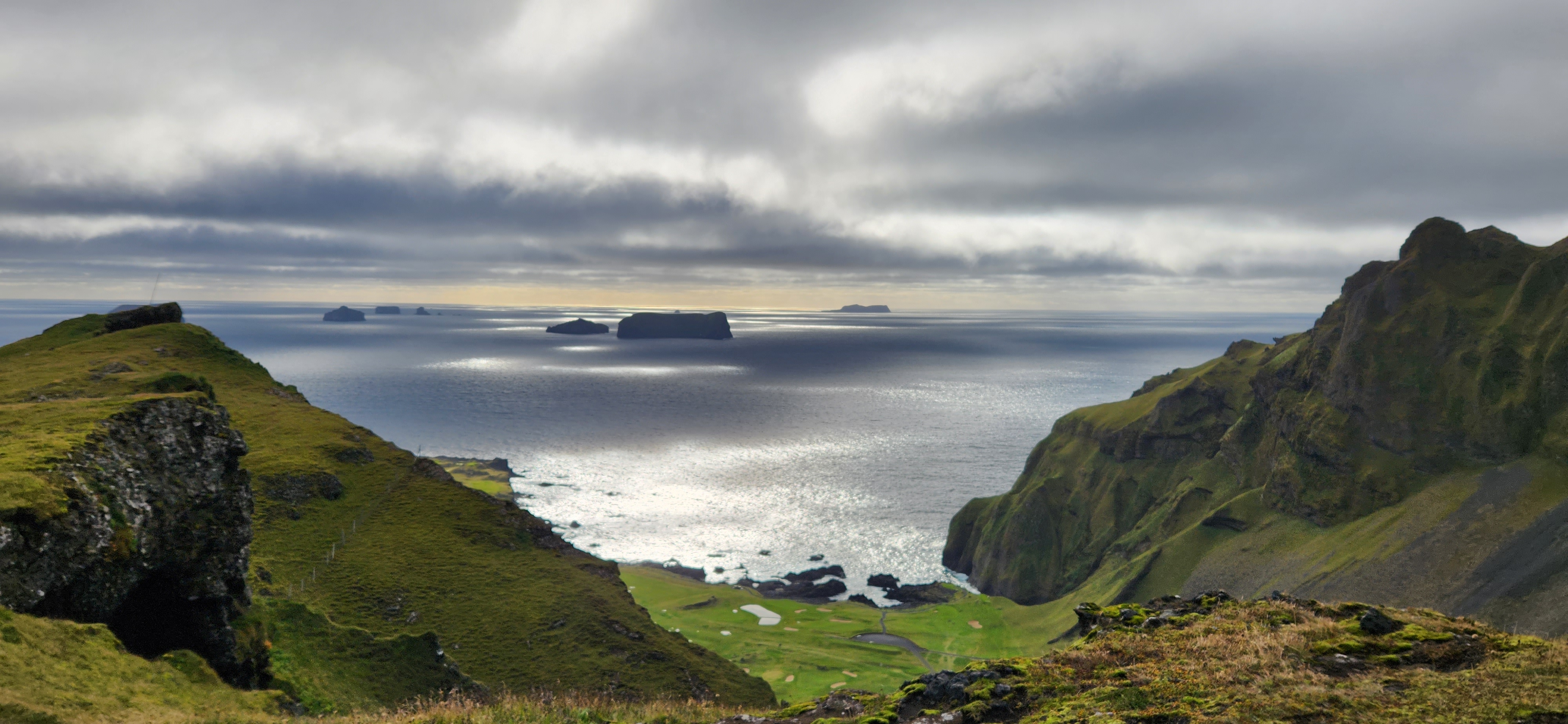


Leaving the island on the ferry.  We missed the puffins, but also missed hoards of tourists.  The timing of the trip was well planned.

Our 2nd night was spent in the town of Hveragerði, (or here) which could be used as a base for touring.  We ended up spending 2 nights in this area (the other in Selfross), but that first night we stayed in the 'Inn Boutique' - an excellent choice and arguably the best placed we stayed at the entire trip (they were all good, but this one was especially nice).

I didn't get any pictures of that place (I should have) but it was an ideal jumping off point for the 'golden circle'.  We ended up taking a bit of a short cut over routes 431 and 435 rather than take route 1 all the way back -- it says it's for 4 wheel drive only, but it wasn't all that bad and we saw sedans as well.  It's narrow, but smooth and easy.  Our first destination was 'Thingvellir', a national park.  The history is too detailed to go into, but this is an absolute 'must see', and reading about it in advance helps the experience.  Between the early 'parliament' of early inhabitants, the geological significance, and the views, it's a national treasure.


There are nice paths to walk around and it's easy walking.  

Next on to Gullfross (or here).  The 'Golden Falls'.  Couple of different parking lots and viewing areas, but again easy access.


Next stop was Geysir on the golden circle.  Although it's another example of geo thermal activity and yes, there's a geyser that shoots steam in the air every 10 minutes or so, it was my least favorite stop.  It's kinda cool, but there's nothing particularly stunning about it,  It shoots steam in the air. There are some great shots at either sunset or sunrise on line, but, well, it wasn't sunrise or sunset.  But steam does shoot in the air.

The last stop of the day was 'Secret Lagoon' (or Gamla Lagoon).  The oldest swimming pool in Iceland.  After driving around, I was a bit tired so I stood this one out, but Leigh and Vera went in and had a nice soak and had a great time.  I had an excellent nap and explored the new Rav4 we had rented for the trip.


Above is a shot Leigh took of Secret Lagoon


That night we stayed in Selfross at a guest house in a camping/RV park.  The cabin had its own hot tub which we made use of both that night and again in the morning.  The soaks were great.

At this point in the trip, the weather was changing.  It had been good to great, but a storm was blowing in that night with winds around 50 MPH.  We decided on a hike up to Hot Springs above Heveragerdi, to the Reykjadalur hot springs.  The link provided is an accurate portrayal of the hike, but has a negative view (the writer complained of bugs, we didn't see any)..  Ours was positive.  This is a modest hike for those who hike a lot.  It's about 5 miles round trip with a fair amount of elevation gain.  If you're not used to hiking up hills, this may not be for you.  My hunch is the reviewer did this review in summer.  Our day was misty with on again / off again rain.  Dressed properly, it was great.  We did have a choice of turning back about half way up, but Leigh wanted to press on and it was good we did.  We didn't take a soak, but it was nice exercise with nice views.  


Signs telling was what to do and what not to do.  


A weather system was blowing in with expected wind gusts of up to 50 mph hitting just after midnight.  During the hike it was evident the weather was changing, but we had sufficient window to make the hike, get back, have lunch at the bottom then press on to Reykjavik, where we would spend our two final days in Iceland.

Scenes from Reykjavik.  The town is relatively compact and very walkable.  We stuck to the older school style of shopping and museums, but there are other attractions using technology that might be fun if one was so inclined -- like the 'fly over iceland' attraction or the Perlan Museum.

 A couple of the streets were walking only which made for relaxed shopping.
s
The Lutheran Church, Hallgrimskirkja, affords a great view of the city.  We were there on a Sunday, which forces the ushers to wear multiple hats.  The church converts from a church to a tourist attraction and back a couple of times Sunday morning.  The ushers wait until the last parishioner leaves the church then start letting the tourists in.


Leif Erikson is prominent in iceland.


One of the Cafe's we were in.  

On the 2nd morning Leigh and Vera left early to catch a plan to Ireland, I walked the city, hit the Maritime Museum and flew out that evening.

All and all a great trip blending outside activities with inside ones.  A nice trip to see interesting and awesome forces of nature as well as gain some insight into the icelandic culture and the tenacity of humans in general.  A great trip with an arc that Leigh designed that suited us well.


One last pastoral view from our first morning in Iceland


Sunday, February 7, 2021

PODCAST FAVORITES


I was talking to a classmate yesterday and mentioned a podcast and woke up this morning and had two thoughts.  First, I do like working on projects listening to podcasts and learning.  Working with my hands while listening to interesting topics and learning is fulfilling.  The second thought was I’m happy with my current stable of podcasts, but always looking for more.  I don’t know what I don’t know.  So below are my current favorites.  Leave a suggestion or addition in the comments! 


News

The Daily – M-F, am, New York Times, deep dive on one subject the NY Times is covering

Today Explained – M-F, pm, Vox – different format than the daily but typically deep dive into one subject

Global News Podcast– I think it’s twice daily, from the BBC and a recap of world news (from a colonial power point of view)

Wonky Political stuff:

The Weeds – from Vox, various policy discussions, leans progressive, but not rabidly so

The Ezra Klein Show – Former Wapo Journalist, co-founder of Vox, now working for NY Times.  “Explanatory journalism” would be a decent description of his approach.  Wonky guests talking about policy and policy options on a wide range of subject.  Informative, low key.

Gzero World with Ian Bremmer – various guests discuss global affairs.  His specialty is global risk factors

Stay Tuned with Preet – Preet Bharara, former US attorney, breaks down legal topics – good source for separating ‘legal’ from ‘political’.

Shoe Leather Politics – the older brother of one of my sons friends puts this out.  Interesting history / political commentary ‘between the handshakes of respect’.


Other stuff

The Economist – Podcast from the Economist Magazine

New Yorker Radio Hour

Tides of History:  Patrick Wyman brought the middle ages and the fall of Rome to life in his podcast and recently delved into pre-civilization history and how homo sapiens, Neanderthals, and other humanoid predecessors lived and roamed the earth.  Highlights what we know – and don’t know – and does so in a highly entertaining way.

American Scandal – focused on past ‘scandals’ in history:  Three Mile Island, Exxon Valdez, Volkswagon Diesel Scandal, The Plame affair, Enron, Iran contra and others.  Usually multi part deep dive into specific stories

American History Tellers – Interesting series on past events

Ice Coffee – History of human activity in the Antarctic – the sound quality is not great, and he’s an acquired taste, but Matthew Alan McArthur gives an irreverent view of his place of employment.  Antartica.

The Moth Radio Hour – compelling personal stories


Saturday, January 30, 2021

SHEARWATER PASSES BETWEEN GOOD HANDS


Shearwater's New Custodian

So here’s a fun small world story.  It starts with Bruce.  I can’t remember when I met him, but it was during college years and there was a group of us with a common attraction to boats, water, and Islands.  And, perhaps, just a little bit of beer.  I had made my first foray up to Alaska aboard a leaky wooden sailboat with no electronics back in 1978.  It must have been ’83 when Bruce and I hatched a plan to take his soon to be new boat up to Juneau and Glacier Bay.  He bought a 21’ Bayliner and called it “Moxee”.  We ended up taking that pocket rocket up to Juneau and Glacier Bay and started tacking more stories to our fairly long list of stories even then.  Bruce still retells them.  Some of them are actually true. 

Over the years, Moxee gave way to Moxee II, then Moxee III.  Power boats all, the last one a Trawler.  Each a platform for fun and adventure with family and friends.  Then he went back to his roots and bought a beautiful blue hulled passport 40, “Shearwater”.

I was fortunate enough to be on her during one of her first shake down cruises.  A rollicking sail over to Friday Harbor with some excitement.  We nearly dismasted it (the starboard upper was the leeward shroud and I just happened to notice it had become disconnected just prior to a planned tack), then we lost the inflatable, and when we cranked on the engine, the chop had shaken sediment laying in the fuel tank and clogged the fuel intake line.  Under sail alone we sailed into Friday Harbor for a picture perfect dead stick landing.  From our perspective.  For the crew on the ‘Silver Shalis’, it was nerve racking.   A nearly 200 feet, the brand spanking new Delta Yacht had its owner on for his first stay on his new Mega yacht.  With the Shalis crew pearing down from above, we greased down the side of it under sail alone to stick the landing in the open dock in front of the Shalis.  The owner had recently received a 4 billion dollar insurance payout from one of his properties.  The downed twin towers in New York. 

Over the years, Bruce and Carol lavished love and adventures on that boat.  It was a fresh water boat and they transformed it into a full fledge all season cruising sailboat.  6 or so years ago I was up in Desolation Sound, ran into Bruce as well as Andy and Jill Cross.  We tied the 3 boats together, enjoyed a great day – so much so we simply hit ‘repeat’ for the next day.  One of the truly great cruising memories.  For 11 years that boat was upgraded, loved, and used.

Fast forward a couple of years.  I can’t remember when I met Kristin Pederson.  It may have been at one of the Sloop Tavern Cruises, but I became a fan of hers.  Solid sailor, competent, and I followed her and Elena’s "Team Kelp" R2AK bid in 2017.  So  much so that I would wake up and yell at my screen when I saw they were sleeping way too much and not attacking the race as aggressively as I thought they should (they had no intention of attacking it aggressively and if I do that race again, I may take a page out of their book).  Kristin has been aboard Cambria with friends for dinner and helped on Race Committees aboard Cambria.  She was always thinking 2 or 3 steps ahead and had knack of being at the right place at the right time. 

My perception was confirmed when I spoke to a very tenured delivery captain with whom she had sailed.  He had a very high opinion of her seamanship skills.  Praise I don’t think he gives out often.

Up until a few weeks ago, Bruce and Kristin didn’t know each other and I’ve never mentioned one to the other.  Two completely different phases of my life two completely different groups of friends.  Bruce lives in Anacortes, Kristin in Seattle.  No overlap at all.  Until I get two messages spaced about a minute apart.

Kristin:  “I think I might buy a boat and the current owner says he knows you.  His name is Bruce Van Iterson”

Bruce:  “Do you know Kristin Pederson?”

And so the beautiful blue hulled passport 40, “Shearwater”, goes from one quality set of hands to another set of quality hands.  It’s been fun to watch.

Wednesday, December 30, 2020

THANKFUL FOR 2020


I am personally very thankful for this year.  2020.  Seriously.  Genuinely thankful.

It was a miserable year for humankind and armed with a magic wand I would have changed it in an instant.  I can’t change the virus, politics, unrest, lockdowns, racism, or oh so many other things.

What we could control was our response to the virus and the other things.  It was, and is, a massive curveball nobody asked for.  Along with hundreds of thousands,  I was furloughed with virtually no notice.   I had made my wishes known in advance should tough choices need to be made and my wishes were followed (be careful what you ask for).

Virus and furlough.  Learning new concepts and words.  Social distancing, PPE, flattening the curve, hospitilizations, ventilators.  Frightening, but I had four advantages. 

First was Leigh. Strong, smart, medical background, flexible, a great partner with whom to discuss and parse information. 

Second were the discussions I had in the eighties regarding the AIDS epidemic with my medical doctor father.  The viruses, methods of transmission, etc are totally different from each other, but there were parallels.   Overblown hype, uninformed news, uneven adoption of safe practices, and fear accompanied both pandemics.  Over reaction and under reaction were both problems.  Dad was able, with his sober medically trained mind, to break things down for me and we chatted about it. The virus was the enemy and there were ways to avoid it.  One can never reduce the risk to zero, as a Mayo Clinic professor acquaintance of mine said, crossing the street carries some inherent risk greater than zero.  Risk mitigation, not elimination, is the key, along with acceptance of the residual risk.  You do what you can, and accept the result.

The third advantage was a bio tech email shared with me by another buddy back in early April.  The note was from their CEO who succinctly described a 12 to 18 month event, which at this point (December of ’20) seems about right, if not a tad optimistic.  Wrapping my head around a long term event, not wasting any energy or thought about ‘getting back to normal’ were keys to charting a path forward.

The final advantage was the hobbies or pursuits Leigh and I like to do.  Backpacking, hiking, kayaking, boating, visiting the island.  All covid friendly pursuits where minor tweaking, not drastic change, resulted a safe and rewarding experience. We didn’t make a habit of hitting bars, or revolve our life around eating out or attending concerns or sports arenas.  Occasionally yes, but not central pursuits.  The outdoors has always had an organic gravitational pull for both of us and that remained ‘in scope’ even with the pandemic.

So when the virus really hit, we were, unexpectedly and without real forethought, prepared.   Our experiences, pursuits, and relative financial health put us in good position.  The thing that probably tipped the balance was ready access to unemployment and the additional $600/week of unemployment.  I’ve never, in nearly 50 years of working, have ever taken unemployment.  It was, for 3 months, the difference between a little financial discomfort and no discomfort. It deferred the worrying should furlough turn into lay off.  Fortunately we returned to our jobs prior to the cessation of the extra $600.  Did we deserve it?  No.  Are we grateful?  A resounding yes.

Leigh was out of work for 2 months and I was out of work for 3.   After applying for the unemployment and realizing that we were in a fortunate position, the value of time shifted dramatically.  From a precious, carefully managed resource to a thing of abundance needing to be thoughtfully filled.  With no time to plan, we just started making decisions.  The greenhouse took shape.  A 9 by 5 underutilized patch of the yard was designated as the ‘site’ and we started digging.  And digging.  And digging.  A retaining wall needed to be built, the site leveled, water and electricity plumbed in, walls framed, roof joists made and custom glass installed.  None of which I had ever done before.  Early on I realized I was not ready for retirement and I needed something to ‘do’.  And by ‘do’, I mean plan, worry about and execute.  I worried a lot about the greenhouse.  There are seemingly an infinite number of ways to do certain things and the choices need to be first understood, then evaluated, with one path selected.  Over and over again.  It was both agonizing and fun and we are both happy with the final result.  A Leigh designed, Mark built, she/he shed serving as intimate wine bar and dining room. An office during the day. And a greenhouse.

We also continued our January/February plan of camping each month.  Somewhere, somehow. Each month.  The goal of camping each month locked us into a better planning cycle.  Which weekend was the camping weekend.  We got out on the kayaks more, camping on Blake Island and both Hope Islands, one in each end of Puget Sound.  We backpacked up on Mount Adams, camping at 7000 feet during the summer and went back near Mount Adams late in the Fall to spend a rugged night with 35 mph winds and 15 degree cold (without windchill).  We car camped near lake Cushman and near Port Townsend, slept a night on the beach in front of the cabin and during the middle of the lockdown spend a night in the backyard.  We spent two very social outings with Becky, pitching a tent near her trailer, one near Mount Rainier, and once on Whidbey island.  Hikes and trail runs accompanied both outings.

We also redecorated the little cabin.  Framing pictures, arranging and rearranging them, and planned a kitchen remodel (this winter, but in 2021).  We spend more time on the island and had great meals up there with mom.  While most were foregoing holiday meals, we time shifted, having two thanksgiving feasts and two Christmas feasts. 

We started using zoom, staying better in touch with friends that we’ve done in a long time. 

All this in a year where the general perception was staying home and lying low – which we did as well.  Our personal ‘bubble’ was very small.  Family only and even then being careful. 

Given all that has gone on, we are thankful for 2020.  A pivotal year, but one for which we are thankful.  For us, it was that age old lesson of being handed lemons and making lemonade.  There’s much truth to that adage.  What we couldn’t do filled volumes.  Figure out what you can do and do it. 

We are thankful. 

And now some pics that capture the year.  The green house had humble beginnings.  The only logical site was a sloped bit of land between the raised beds and the deck.  So excavation was done by hand and took some time.


Leigh did a ton of work.  Neither one of us had played with mortar much and it was a fun learning experience.
We had many 'builder / architect' discussions.  For the most part we communicated pretty well -- Leigh had the design in her head and here we're trying to get the roof height, angle, and overhang right.  

We had bought a vintage window from Earthwise Salvage -- they had salvaged a 1908 capital hill house


The window had some 15 coats of paint on it and Leigh stripped it down to wood, glazed the panes and finished the trim.  Paint on the outside and varnish on the inside.

Getting there


Pretty much the finished product with only that upper window left to complete.  It's an opening window with an automatic opener for hot days.

The inside -- a she/he shed that serves as an office, wine bar, intimate dining room and, oh ya, a green house.


Some other shots

This was the view from the tent in June when we camped at the beach.

We got a lot of use out of the back yard during the summer.  

After the lock down had eased a bit we cruised the south sound.  And wrote an article about it.


Given the separate living quarters on the island, visits became more frequent.


I also rebuilt Dad's gate to the house. The original had rotted and was falling apart.

Way down towards the bottom of this pic is Leigh and I.   A photographer caught us peering up at Mount Adams.
Another backyard fire...
 A marmot on Mt Adams poised with Rainier in the background,

Leigh watching the sunset from 7000 feet up on Mount Adams.


Backpacking

Leigh and Vera kayaking


Monday, April 13, 2020

VIRUS OUTBREAK IN THE NORTHWEST. A CAUTIONARY TALE.


The virus entered the town on March 12th.  Unseen, unfelt.  Silent circulation within the community was later to send public health officials into dramatic action with dire consequences.  Six days later, on March 18th, the news reported the first confirmed case.  Two days later another one.  The outbreak had begun in the Pacific Northwest bringing widespread panic.


But this isn’t current day nor is this the Covid 19 virus.  This was a known entity and a vaccine had been developed.  Quarantine protocols were known to all.  This is a true story that took place 158 years ago.


1862.  Victoria in what later was to be come British Columbia.  Four years since the gold rush on the Fraser River, Fort Victoria was on the verge of becoming a ‘city’.  A mixture of wild west with a British heritage, Victoria growing and on the move.  Later that same year the ‘Female Emigration Society in London’ was successful in bringing 62 marriageable young women to the predominantly male society aboard the SS Tynemouth. That year also marked the first gas lights on the streets of Victoria as well as first public baths. 


Enlightenment and egalitarianism were not hallmarks of 1862.  Civil war was raging in the US and the prevailing opinion on natives was certainly not one of openness and acceptance.  Wealth created by growth and opportunity in this still young town becoming a city spread unevenly with English bred Caucasians enjoying the center of it while Natives in various encampments around the outskirts of Victoria getting the scraps.  Natives from various tribes and villages up the coast to Juneau had temporary camps around the more prosperous center of town.


The arrival of the steamer ‘Brother Jonathon’ from San Francisco started the outbreak.  Built in 1851, the 220 foot paddle wheel steamer had been owned by Cornelius Vanderbilt, and was presently owned by the California Steam Navigation Company when it steamed into Victoria on March 12, 1862.  This was the same ship that 3 years earlier delivered the news to Portland that President Buchanan had signed the bill officially recognizing Oregon statehood.  But on this day the ship arrived with about 350 passengers, mostly seeking a recently announced gold strike along the Salmon river, along with an invisible, yet far more sinister, cargo.


Smallpox, like the Covid 19 virus, is highly contagious prior to presentation of symptoms.  Completely unaware, a person can go about their normal activities unknowingly infecting their associates, their family and strangers through moisture droplets of breath.  Once the incubation period for smallpox is over, the symptoms arrive suddenly.  Severe chills, high fever, loss of appetite followed by the characteristic lesions which eventually kill the skin.  If the person survives the initial symptoms, they may succumb later to secondary infections. The fatality rate is between 30 and 75%, depending on the strain of the virus and the one introduced into Victoria in 1862 was particularly virulent.


Smallpox was with us as humans for at least the last 2,000 years.  It was a well-known and feared disease.  Between 1796 and the mid 1800’s progress on vaccinations and regulations surrounding their use were steadily advancing.  Between 1843 and 1855 Massachusetts then three other states mandated smallpox vaccination.  While only recently eradicated, the human experience with the virus was well documented by the mid 1800’s.


By 1862, the medical professionals in Victoria knew how to deal with smallpox through vaccination, inoculation or isolation to prevent spread.  Isolation can come in two forms.  Either bring the infected persons together in a state of quarantine and insulate them from the outside population or sequester the healthy population together and expel the infected persons to outlying areas.  Or combinations of those three general techniques.   Which brings us back to what the government faced in 1862.


Predictably fear and panic spread.  Just as now, rumors and misinformation mixed with substantive fact.  The danger was real and newspaper articles of the day fanned the flames of public opinion.  There was some vaccine available, but not at times not enough, so inoculation, the less safe practice of taking virus  from a diseased person and injecting it into the superficial layers of the skin of a healthy person, was more generally used.  Both methods were not 100% effective, and both had risks.


On March 26, just 2 weeks after the arrival of the steamer, the Daily British Colonist advocated for the removal of all natives to protect the health of the colonists and warned of great danger amidst government inaction.    Attitudes along these lines had been prevalent well prior to the arrival of the virus, but the arrival of the virus gave new push to old sentiments.


For the next two weeks, the citizens of Victoria were urged to get vaccinated and by April 1st, roughly half of the residents of Victoria were either vaccinated or inoculated per the Daily British Colonist.


Throughout April of that year, the smallpox virus spread quietly through the Native population around Victoria.  Unseen at first, the toll worsened each week as the government wrestled with what to do, with English whites getting the benefit of vaccination and medical care.  By the end of April, a strident press increased their demands for government action to remove the increasingly sickly and decimated native encampments. 


Throughout this the tribes local to Victoria and the Puget Sound area appeared to receive vaccinations.  The tribes from the north camped around Victoria did not.  Encampments from at least 5 Northern tribes were suffering horribly at the end of April and the government actions lead to the inescapable conclusion there was far more concern with the risk to the white population and little if any regard for the welfare of the natives.


With Natives dying at an accelerating rate, authorities began expelling Natives, first with demands, then finally, on June 11th, at gunpoint.  The gunboat ‘Forward’ took a 15 day trip up to Fort Rupert with 26 canoes in two from various tribes.  What was left of the native population was expelled north.  Along with the smallpox virus.  The suffering and devastation that followed was horrific.


Robert T Boyd, in his work The Coming of the Spirit of Pestilence: Introduced Infectious Diseases and Population Decline among Northwest Coast Indians, 1774-1874, estimated that some 30,000 aboriginal peoples lived between Victoria and Juneau in 1862.  Over the course of that winter, 1862/63, roughly half would perish to the ravages of smallpox.  The rate varied amongst the tribes with some populations being cut by two thirds. 


I’ve read of other accounts with much higher death rates.  What is known is clear.  The virus was introduced to Victoria.  This was a known virus with known remedies.  Infected natives from a variety of tribes were removed at gunpoint with predictable end result.


There are vast differences between smallpox and COVID-19, but similarities as well.   Ultimately history will judge how we dealt with this new virus and the values we employed to fight it.  History will judge our collective actions, whether on the front line as health workers, people getting needed product to market, or those of us sheltering in place.  History will have the final word.  The cautionary tale of history should trigger thoughtfulness and long range thinking in how to deal with this new virus.

Tuesday, January 28, 2020

January Kayak to Blake


We had originally planned to take ‘Cambria’ over to Blake.  42 feet long, two staterooms, two heads, a large salon with a Dickerson Antarctic diesel heater that bathes the entire boat with delicious heat.  Between that and a covered cockpit, Cambria is made for winter cruising.  Perfect for the 5th annual Sloop Tavern Yacht Club January Blake island cruise. 

Except for the pesky raw water pump which had been ordered, but hadn’t yet arrived.  Cambria was disabled until it was replaced.  


Leigh and I both independently came up with the idea to kayak over.   The party was too good to miss.  Great people, great location and that party seems to kick off the cruising year for us.    The tandem is a virtual station wagon and the weather looked ok for paddling Saturday and Sunday with a wind event sandwiched between the paddling times. 

Steady rain and steady wind would have deterred us, but we could deal with a mix of weather and as it turned out, the weather as a bit better than our expectations.


What’s so special about this particular cruise?  The people.  This isn’t your fair weather cruise crowd.  Not that there’s anything wrong with that, but this particular group of people year after year are experienced, interesting, and the conversations around the fire are entertaining and illuminating.

Saturday morning was a case in point.  Over coffee an interesting discussion revolved around war movies, world war I and II.  A few of us had seen ‘1917’ and the  movies touched discussed were Gallipoli, They shall not grow old,  Dunkirk, Midway, among others.  Informed views discussed over coffee and a fire.  Guys and gals, and a mix of generations contributed to what I found was a fascinating discussion.  The weekend was full of discussions, reacquainting with old friends, making new acquaintances, just a wonderful time.


Overall the kayak camping worked well.  The only real failure came in the morning after we had gone to the shelter to make a fire and crank up coffee.  Wind gusts increased and finally the tent partially collapsed.  Had that happened at night with the rain, it would have been a different story. 

Our learning with the kayak continues and I need to give thought to a navigation set up so I can better compensate for leeway.  


.