Thursday, September 22, 2016

NEAH BAY TO SAN FRANCISCO


The send off committee in Neah Bay

The drive out to Neah bay was interesting.  We had a Bernie loyalist, a Hillary supporter and a disenfranchised conservative stuck in a car together for 4 and half hours.  The conversation was interesting and despite the political differences, we agreed far more than we disagreed.  All parties had a good time with the discussion. 
In any case, the game plan was for Leigh to drive Adam and I out to Neah bay to crew on Jon and Michele’s Beneteau, Ardea, and get the boat down to San Francisco.  800 nautical miles down the coast.
Upon arriving in Neah Bay we decided to leave that night instead of the planned early morning departure.  A weather system was moving in and by leaving a little early we’d miss its effects.  So we left a 9:30 pm (2130 hours to you sticklers).  I was comfortably in my bunk as I has the 3 to 9 shift. 
Watch systems are critical and the prescribed schedule  was a staggered 6 hour watch with each of the four on board taking two 6 hour watches each day.  The first 3 hours of any watch would be spent driving, the second 3 hours would be support.   The goal was to have two people in the cockpit at all times.   One would start at 3 (mine) and last till  9, the next would start at 6 and end at noon, then 9 to 3 and finally 12 to 6. 
We later agreed that the system could have been tweaked a little.  It didn’t allow for enough sleep.  We adapted a little into the voyage and ended up getting sufficient sleep until the final 2 days where the wind and weather conditions were nearly ‘unsleepable’.
Watch systems are an interesting topic.  At the root, it’s a balance between sleep, managing a proper lookout, having sufficient resources to manage the boat and to ensure safety in the cockpit. Sleep vs safety, but adequate sleep enhances safety.    In my own view, a system has to be flexible.  Beating to windward in forecasted rising winds with several tacks  in a congested waterway between midnight and six am may require one set of resources whereas a nice down wind in run open waters in stable wind conditions with no predicted gybes or tacks would require fewer resources.
What a compass looks like as your head bobs down just before your eyes close

At the end of the day, we kept to spirit, but not the letter of the prescribed system and it did work.  If we had to replay everything over, we may have given more emphasis on sleep and to that other all important role on a boat.  The exalted position of ‘snacktician’ is a non-trivial task and to divide the watch system into four equal parts then load up one of those roles with the additional tasks of cooking and cleaning not only isn’t fair, it robs that person of needed sleep. 
We spent a little time reviewing the watch system at the end of the trip without landing hard on what the ‘right’ equation looked like.
Back to the trip, we motored for the better part of two days looking for the elusive wind.   Michele termed the VHF radio the ‘box of lies’ when it came to weather forecasts as the weather models kept evolving. 
While motoring was getting a little old, fishing for tuna was perfect.  They had rigged line with a little surgical tubing to take up some of the slack.  When the tubing stretched, fish on.   Jon pulled in both fish, I gaffed the first, Adam gaffed the second.
Jon with the first fish of the trip


Adam with the second and last fish of the trip

Both Tuna were caught on this simple wooden plug
Nothing better than fresh Tuna
Between Jon and Michele, wonderful things happen to Tuna after they come aboard.  I'm quite sure the Tuna themselves would have an alternate viewpoint, but between the Ceviche, Sashimi, smoked tuna and a fantastic Thai soup, the tuna were transformed into tasty meals.


Evening sashimi
Finally just after midnight on the second day the jib was unfurled and the sailing began.
We were visited by a small pod of ‘Northern Right Whale Dolphins’.  Adam and Jon saw one doing a ‘tail walk’ along the lines of Flipper.  I had never heard of them and they are distinctive for their lack of a dorsal fin.

Not my picture -- but stock photo of a Northern Right Whale Dolphin
My picture of the crew looking at the Northern Right Whale Dolphin
Pacific Whitesided Dolphins playing with Ardea's bow
We were also visited several times by Pacific Whitesided Dolphins.  At night they left streaks of bioluminescence.
We did sail in the fog. 

 For nearly two days we had some degree of fog.
But on clear nights, sunsets were great.

Michele updating her journal at sunset.


You know they're big when you need to look up to them.
The wind freshened the last two days.  Early Sunday morning, just prior to 3am, we were barreling along wing on wing at 7 or 8 knots.  I was still asleep forward with the alarm set to go off in about 2 minutes.   I went from blissful sleep to bolt upright as there was a huge THUMP and the boat nearly stopped dead in the water.  We had hit something large.
Several thoughts flash through the mind at that point, but being close to, if not right on top of the point of impact, I dropped to the floor and started pulling up floorboards.  Earlier in the spring, at the end of the Oregon Offshore Race, we had hit a telephone poll broadside on Andy and Jill's boat and the sound was about the same.  A sickening and solid 'THUD' to be sure, but not a crash or a cracking sound.  I did a quick check and Jon came forward for a more thorough check while Adam went forward on deck to assess.  Michele was up as well checking other areas of the bilge.  All was OK.  
No one saw what we hit, but my guess was a decent sized log.  With enough mass to nearly stop the boat, but soft enough not to leave a dent, scratch or other visible sign on the boat.  All and all a good wake up call on a couple of levels.

Things were getting back to normal after the THUMP when we rounded up slightly and the boom preventer parted with a load snap that reverberated throughout the boat.  We had to make a couple of course changes to again secure the preventor.
Right after the hit then the snap, the crew was getting our collective wits together and an odd scenario set up.  Another Beneteau had been visible on AIS and had marched on in front of us, stern light visible in the far distance.  Unknown to us, they had dropped off AIS and another target, a powerboat, appeared in their place going the opposite direction headed towards us.  There was minor confusion sorting that out.  Michele was on the AIS below and the other 3 were in the cockpit.  We saw the running lights and gyped to port tack, crossing in front of the powerboat.  Only their red light was visible, so in effect we had put ourself in position of finding their green light to come in front of them.  After a few seconds we gyped again and put ourselves safely out of harms way.
It was one of those events where tired humans were wrestling with several things at once.  Just minutes after the 'THUMP' we had a crossing situation with 20 or so knots of wind.  There was minor communication issues as input was provided to 'head west' but that takes some processing.  The confusion was only momentary and all was resolved in a few seconds, but it was a good cautionary tale.  Clear communication ("steer Starboard 90 degrees" may have helped.  In any case, although both we and they were transmitting on AIS, there were no hails on the VHF and there were no horns sounded.  While we were uncomfortably close, there was sufficient distance and plenty of time for more evasive action that mercifully wasn't needed.
The wing on wing run was good for quickly closing the gap to San Francisco, but the boat rolled from side to side as we barreled along.  So much so that sleep was difficult for all.
The last day was in 25 knot wind and the waves were impressive.  Ardea handled well and that Monitor wind vane, now named 'Toonces"after an old Saturday Night Live Skit.  The monitor wind vane did considerably better than its namesake and kept a great course relative to the wind.
Coming into San Fransciso was a little anti climatic.  I think all were ready for some rest. 


 The Point Bonito light house stands guard just outside San Francisco Bay.  It was the first lighthouse on the west coast with a fog horn and was the last manned lighthouse on the California Coast.  Originally built too high to be effective in low level fog, it was moved in 1877 to its present location.


The Golden gate bridge shrouded in fog.


One of the few selfies I've ever taken, Golden Gate Bridge in the background.
All in all a good passage with good company.  Ardea is a solid boat that sails well.  Adam and I were fortunate in sharing an early leg in Jon and Michele's long term voyage plans.  Fair seas and following winds! (which we think is better than the original fair winds and following seas quote).


Monday, August 29, 2016

PATOS ISLAND LIGHTHOUSE KEEPER


Harold Faust was a 28 year old Coast Guardsman when he was assigned to Patos Island as a lighthouse keeper.  His wife Helen described it as a scary time.  Their son, Mike, had been born just 6 weeks before.   Daughter, Kathy, was 3 years old.  The year was 1960. Dwight Eisenhower was president, and the cold war was running hot.

Just 8 years earlier, during the Korean conflict, Harold had made a choice on which his future life would pivot.  Raised in Green Bay, Wisconsin, he had strong childhood memories of WWII.  The Wisconsin and Michigan National Guard (the 32nd Division) had amassed more days in combat than any other division during the war and the community of Green Bay paid a terrible price.    

Drawing a low draft number in 1952 Harold had to make a choice of which service in which to enlist.  Four years were required by the Army and Navy.  Same for Marines.  When making his rounds of the services, young Harold Faust had his first and only question ready for the Coast Guard.  “How many years”.   The response was “three”.  Done.  Harold made his decision.  Little did he know then he would stay in for the next 26 years.

Present day Patos Island Lighthouse

Accepting a position on this lonesome island bore heavy responsibility both personally and professionally.  Remote and isolated, Patos Island is the northernmost island in the San Juans.  Harold and Helen, along with 3 other families, would have to be largely self-sufficient as they maintained both a young family and the infrastructure to keep the lighthouse operational.

The Lighthouse, along with its companion on the southern end of Saturna, marks the transition between the Strait of Georgia and Boundary Pass.  Currents can swirl through and the sailing directions warn of strong tide rips and eddies.  

By the time Harold and Helen arrived, navigators had depended on the lighthouse for over 60 years.   The lighthouse itself was approved in 1893.  Most shipping between Seattle and communities on the inside passage to Alaska passed through this channel and between currents, fog, and reefs navigators needed the lighthouse to ensure safe passage.

Patos from the air in 1940

In the early years the lighthouse was run by the US lighthouse service.  Patos island had several lighthouse keepers beginning in 1893,  but one lighthouse keeper in particular, Edward Durgan, had the extraordinary good  luck of having a writer in his family.  Helen Durgan Glidden wrote a delightful book entitled ‘The Light on the Island’.  First published in 1951, it recalled her early life on Patos between 1905 and 1913.  While all lighthouse keepers performed similar tasks, Helen’s colorful recollections have had a lasting legacy.  Her book has spawned hundreds of visits to the island over the years.

In 1939, the Lighthouse Service merged with the Coast Guard with the Guard talking over maintenance and operation for all Lighthouses.  In 1958, the original keeper’s house on Patos island was taken down and the replacement housing had begun.  Harold and Helen arrived in 1960 and added one additional year to their original 2 year assignment when Kathy tested out of kindergarten.
Fast forward to August of 2016 when I was lucky enough to accompany a spry Harold Faust, along with Helen and two of their children and their spouses visit the island on the 123rd birthday party for the lighthouse.

Management of present day Patos island done by an interesting blend of government organizations along with a nonprofit.  The Federal government owns Patos and is administered by the  Bureau of Land Management (BLM).  As such, Patos is part of the newly created San Juan Island National Monument.  Washington State Parks and Recreation commission operates the campsites on Patos as well as supposedly two mooring buoys.  As of this writing there’s only one. The Coast Guard maintains the light and horn at the lighthouse.  The lighthouse itself is maintained by a non profit, the ‘Keepers of the Patos Light’. 

The 123rd birthday party was organized by the ‘Keepers’ group and Marcia deChadenedes  (Manager of the San Juan Island National Monument) along with BLM Recreation Specialist Nick Teague were among the 25 or so people who attended the event.  Kathy (Faust) Long and her husband Bruce accompanied her brother Greg and sister in law along with the senior Fausts. 

The trip started out with some uncertainty.  Predicted winds had arrived and the ‘Blackfish III’, the aluminum tour boat chartered to get the group from Eastsound to Patos, was retrieving a kayak party who had experienced distress owing to rips and wind driven waves.  While well within the boats capabilities, there was some nervousness amongst the group venturing out on a modestly blustery day.

Roaring out to Patos

Looking astern from the 'Blackfish III'

At 84, Harold wasn’t too worried about the weather.   During his Coast Guard career he had served on ice breakers in both the Arctic and Antarctic.  Admittedly it was a little windy for mid-August, but he’d certainly seen far worse. Helen and daughter Kathy had not been to the island in over a half a century and Harold had not seen it for over 40 years.  Going back to the island would be nostalgic for the entire family.
Kathy and brother Mike on Patos in the early 60's

Kathy and husband Bruce on present day Patos


We approached the island, bouncing around a little but the landing at what Harold called ‘Minnie’s Beach’ went well.  The aluminum tour boat had a landing craft type bow which made for easy access to the beach.  Harold recalled that a former Patos island inhabitant was named Minnie and she loved to skinny dip in the cove.  She’d post hand written signs saying ‘MINNIE’ on the trail providing a degree of privacy for her regular dips.  Hence ‘Minnie’s beach’.

Alden point in the 60's.  None of the structures shown stand today with the exception of the cement wall in front of the house.
The family living quarters as it appeared in the 60's

The trail out to Alden Point and the lighthouse is an easy one with an unexpected paved sidewalk on the final portion of the trail.  Harold recalled laying the cement down a half century earlier and how one of his fellow guardsman’s dog ran through much of the trail leaving dog prints in the cement.   He had the crew redo the work so that no prints were visible (and none are).


Harold pointing out what wasn't there

This was a nostaligic trip for Harold and Helen.  3 years of their life had been spent here and much had changed   As we approached the lighthouse Harold pointed out what wasn’t there.  Gone were the houses they lived in, the water tower and the other out buildings.   The only structure left standing was the lighthouse itself.

Harold and Helen 53 years after their stint on the Island

One feature that remains is the low wall below what was the keeper’s house.   Harold recalled how he and his crew painted “USCG LIGHT STATION PATOS ISLAND” on the wall.   He said the most difficult part was getting the spacing right for the lettering.


Half century later Harold's work still very prominent

Monument Manager Marcia getting first hand history


Harold at the top of the lighthouse

At 84, climbing to the top of the lighthouse posed little challenge
Inside the lighthouse Harold's son Greg and daughter Kathy bracket Harold reviewing the island's history

The Fausts liked living on Patos but were worried about Kathy's schooling as time for elementary school came around.  Balancing career and family interests, Kathy was tested to see if she could bypass Kindergarten.  She passed with flying colors and the family stayed an additional year on top of their original two year commitment.

The final year was marred by a lawn mower accident with young Mike.  Just 3 years old, his leg had become snared when a maintenance worker operated the mower.  Bleeding heavily, Harold called for a helicopter.  Initially he was told the copter was not available, but when he described the severity of the injury, the flight was dispatched.  Mike nearly lost his leg in that incident but now walks without a limp.  An abrupt ending to family's time on Patos.


A family affair sharing the day with Harold and Helen Faust
Two out of three of Harold and Helen's children attended the day's event.  After growing up in a Coast Guard family, both work in Marine related industries.   Harold's long ago choice of three years for the Coast Guard influenced far more than he could have realized.


The 'Blackfish III' cutting between Patos and Little Patos
Final notes.  Patos is a gem of an island and the 'Keeper's' group well compliments the islands history. Organizing work parties and onsite docents, the Keepers maintain an historical structure.   Here's a link to their website.

I asked the Coast Guard about the future of lighthouses in general.  While there's no formal plan, there is an ongoing process of reviewing all aids to navigation.  Lighthouses were built in a previous era prior to electronic navigation.  Some lighthouses still serve a valid purpose as an aid to navigation, others do not.  A light on a pole, in some locations, may now offer the same level of safety as a lighthouse.  The Coast Guard's process focuses on safety, but balances tax payer burden for maintenance.  Groups like the 'keepers' play a critical role by stepping in and maintaining and restoring historical structures that may no longer play the role they once did with navigation.

And a final note of thanks to Kathy Faust Long for including me in their families outing.  I had spent my childhood summers in the 60's on the NE side of San Juan, just over 10 nautical miles away from Patos.  Until this summer I had never visited Patos.  The island is a true gem and getting a glimpse of it from an earlier era was a rare opportunity.


Monday, August 22, 2016

Not a whole lot of blogging

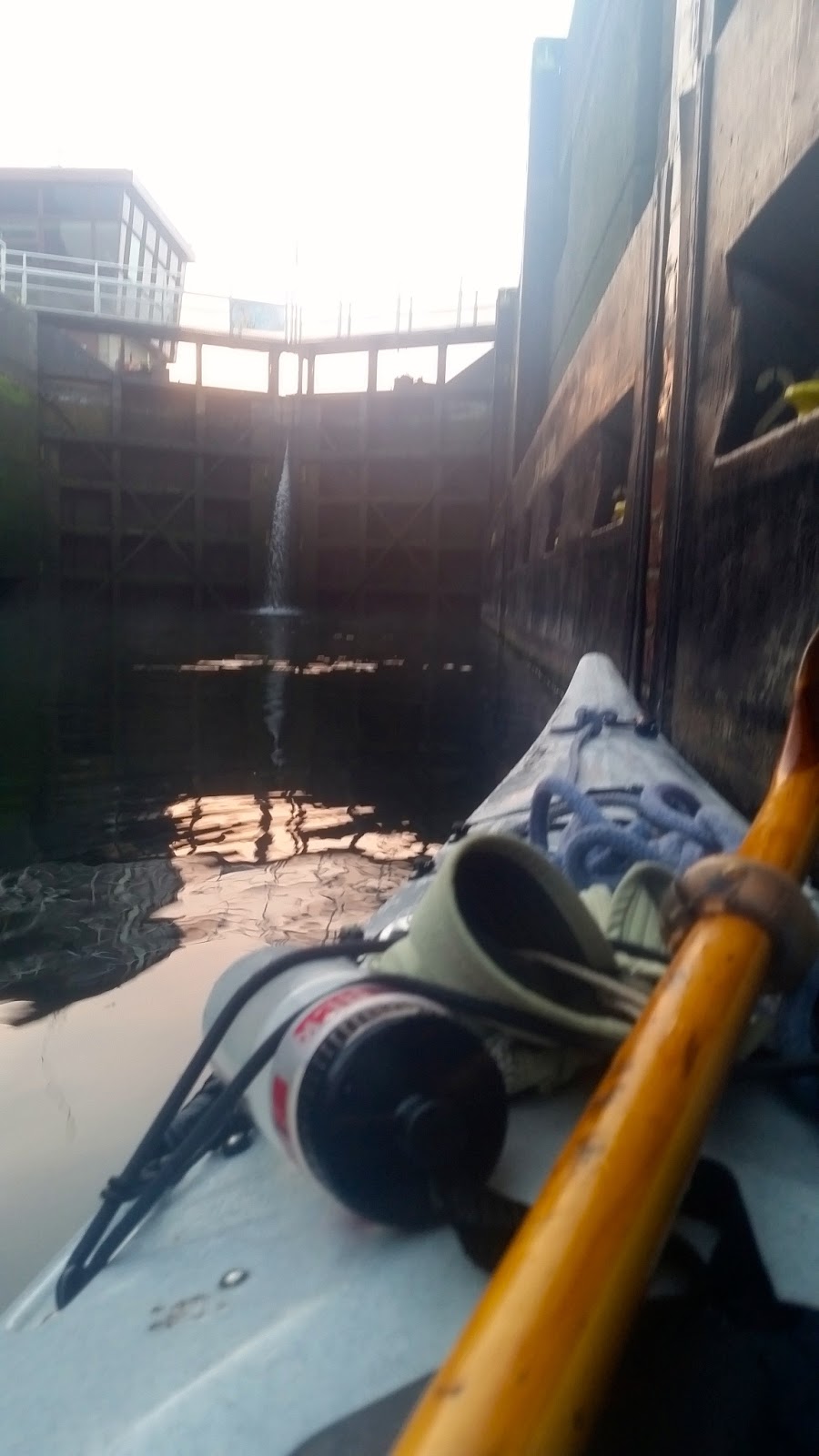
I haven't posted much all summer.   No big trips, but plenty of small adventures.  Take this last week. Tuesday.  For the first time I kayaked to work.  6 miles in the morning, 6 miles home.  OK, not ALL the way to work but Shilshole to Montlake.  Then a bus.
 Thru the locks first

Then into salmon bay at sunrise.  My oh my.

Wednesday was work, but then took an evening ferry to the island.  After a good night's sleep, caught the sunrise.  Nothing better.


And then pitched into work for a couple of days.  Put some good wood on the deck and built a kayak rack.  Nothing special, but good projects...

Jae flew up for a visit, then on Sunday I went over to Patos.  That story will need some work, but accompanied an 84 year old light house keeper back to Patos island.  Stay tuned....